.png)
What Anne Frank Taught Me About the Healing Power of Writing
- Dr. Limor Weinstein

- 3 days ago
- 7 min read
What If Healing Begins With a Pen?
While visiting Amsterdam, I stood outside the Anne Frank House.

As I watched people from around the world gather to learn about a young girl whose diary continues to touch millions of lives, I found myself thinking about something unexpected.
I was not only thinking about history.
I was thinking about a pink diary.
And I began to wonder:
What is it about writing that can help us survive some of the most difficult moments of our lives?

Anne Frank was only 13 years old when she began writing in her diary.
Most people know the tragic ending of her story.
Fewer people talk about why her diary continues to resonate with millions of people today.
Anne did not simply document history.
She documented her humanity.
She wrote about fear.
Loneliness.
Family conflict.
Friendship.
Love.
Dreams.
And the future she hoped to have.
In many ways, Anne Frank's diary is not only about war.
It is about being human during a war.
It is about the power of having a place where thoughts and feelings can exist safely.

Years before I became a therapist, researcher, educator, or founder of Bespoke Wellness Partners, I was a young girl trying to understand her own thoughts and feelings.
My foster family gave me a pink diary with a small lock.
At the time, that lock felt important.
It made the diary feel safe.
Private.
Protected.
A place where nobody else could see what I was thinking.
So I wrote.
I wrote about feeling lonely.
I wrote about feeling sad.
I wrote about feeling different.
I wrote about experiences I could not yet fully understand.
What I did not realize then was that I was beginning a conversation with myself.
A conversation that would continue for decades.
The Weight I Was Carrying

Years later, while struggling with "anorexia nervosa," bulimia, depression, anxiety, and a deep sense of hopelessness, I found myself writing again.
At one point, when I was 21 years old, I wrote what I believed would be my final letter.
Yet something unexpected happened.
Instead of ending my story, writing helped me see it.
The more I wrote, the more I realized that what I was carrying was not simply about food.
It was not simply about weight.
It was not simply about appearance.
I was carrying years of fear.
Years of shame.
Years of self-criticism.
Years of stories I had been telling myself about who I was and what I was worth.
I began filling page after page.
More than one hundred pages.
As the words poured out, I felt something release.
It was as if I had purged the actual weight I had been carrying.
Not the food.
The emotional weight.
The invisible weight.
The weight of silence.
The weight of pain I had not yet learned how to name.
For the first time, I started hearing my own voice.
The Question That Changed Everything
How do we create a new chapter?
For years, I believed recovery meant changing my body. What I eventually learned was that recovery required changing my relationship with my own story.
How do we tell our story in a way that helps us move forward rather than keeps us stuck?
How do we become the hero of our own story instead of feeling like the victim of it?
As I looked around the mental health field, I realized there were many therapies, many diagnoses, and many treatment plans.
Yet I struggled to find a simple roadmap that helped individuals communicate with themselves most effectively.
These questions eventually became the foundation of The Bespoke KARMA Method™, a roadmap designed to help individuals understand themselves, communicate with themselves more effectively, regulate their nervous system, and become the author rather than the victim of their story.
From Talking in Circles to The Circle Game
At its core, The Bespoke KARMA Method™ is a roadmap for helping individuals communicate with themselves in a more compassionate, organized, and empowering way.
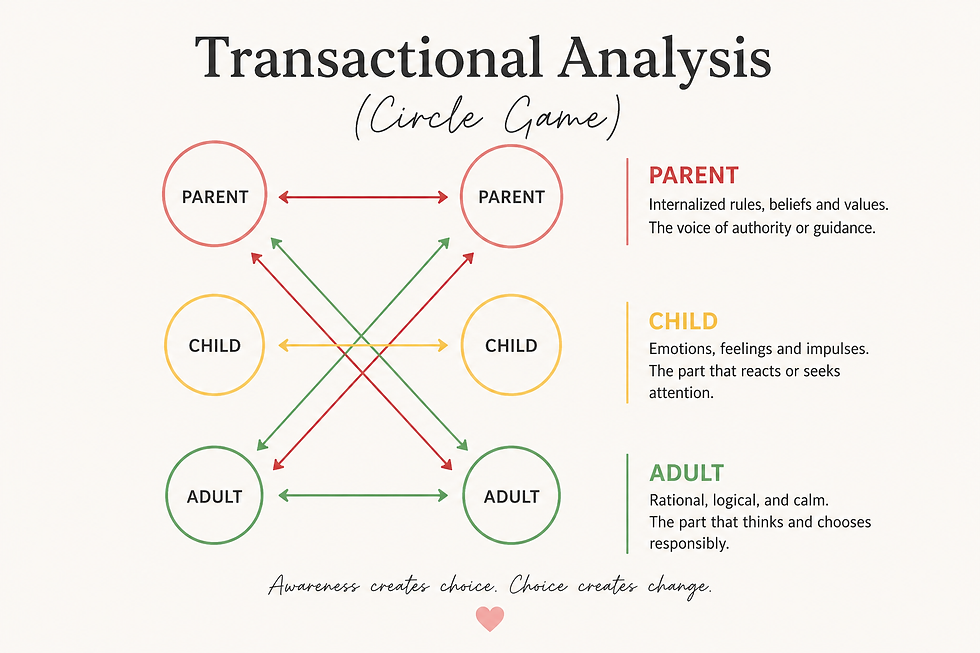
Using principles from Transactional Analysis, which I often call The Circle Game, individuals learn to identify the different parts of themselves.
The critical voice.
The fearful voice.
The wounded voice.
The logical voice.
The nurturing voice.
The empowered voice.
Instead of talking in circles, we learn to recognize which part of us is speaking.
Then we learn how to respond with intention.
What My Research Taught Me About the Vagus Nerve
My second research study, which explored the lived experiences of individuals with long-term "anorexia nervosa," taught me something profound: before people can tell a different story, they often need to feel safe enough to tell the truth. Again and again, participants described experiences of fear, silence, invalidation, and feeling misunderstood. Their stories reinforced the critical role of the vagus nerve and psychological safety in healing.
The vagus nerve serves as one of the body's primary communication pathways between the brain and the body.

When our nervous system feels unsafe, we become more reactive.
More defensive.
More disconnected.
When our nervous system feels safe, we become more capable of reflection, connection, communication, and growth.
This is why healing is not simply about changing thoughts.
Healing is also about helping the body feel safe enough to have new thoughts.
Rewriting the Story
One of the most powerful lessons I have learned through my personal journey, clinical work, and research is that the events of our lives do not determine our future nearly as much as the meaning we give them.
When we learn to redirect, reframe, and make meaning, we begin to reclaim authorship of our lives.
We stop being only the person something happened to.
We become the person who is still writing.
What Anne Frank and Mental Health Have in Common
Over the past several years, my research has focused on language, psychological safety, and the lived experiences of individuals who have lived with long-term "anorexia nervosa."
One of the strongest findings from that work was not about food.
It was not about weight.
It was not about symptoms.
It was about voice.
Participants repeatedly described experiences of feeling unheard, misunderstood, judged, or reduced to a diagnosis.
Again and again, they spoke about the importance of finding environments where they felt safe enough to tell their story.
The same principle appears throughout psychology.
Healing often begins when people feel safe enough to speak and trust that someone is listening.
Not listening to respond.
Listening to understand.
In many ways, Anne's diary served that purpose.
Her diary became the witness to her experience.
It held her fears.
Her dreams.
Her frustrations.
Her hopes.
And through her words, millions of people continue to listen.
Hope in Darkness
One of Anne Frank's most famous quotes reads:
"In spite of everything, I still believe that people are really good at heart."

Many people are amazed by this statement because of when she wrote it.
She wrote it while living under extraordinary fear and uncertainty.
Yet somehow she maintained hope.
Whether one agrees with her statement or not, it reveals something profound about the human spirit.
The ability to hold onto hope, even in darkness, may be one of the most powerful forms of resilience.
What Anne Frank Reminded Me...
When people visit the Anne Frank House, they often expect to learn about history.
And they do.
But many leave having learned something else.
They leave thinking about humanity.
About the connection.
About the power of words.
About the importance of telling our stories.
About the need to listen to the stories of others.
Anne Frank dreamed of becoming a writer.
She wanted her voice to matter.
She wanted to leave something behind.
She succeeded beyond anything she could have imagined.
More than eighty years later, her words continue to remind us of something we all need to hear.
Every person has a story.
Every story matters.
And sometimes the most powerful act of healing is simply creating a space where someone feels safe enough to tell theirs.

Reflection Questions
What story am I currently telling myself?
Is this story helping me grow or keeping me stuck?
What emotional weight am I still carrying?
Which part of me needs compassion today?
What would the next chapter of my life look like if I became the author rather than the victim of my story?
Final Thoughts
If you are struggling today, begin with a blank page.
You do not need perfect words.
You do not need a perfect story.
You do not need to know the ending.
Just begin.
Write what you feel.
Write what you fear.
Write what you hope.
Write what you need.
Write the truth that has been waiting inside you.
Because sometimes healing begins with a conversation.
And sometimes that conversation begins with yourself.
Anne Frank's diary reminds us that words have power. They can keep us trapped, or they can help set us free. They can reinforce shame or create hope. Most importantly, they can help us make meaning from our experiences.
Whether your story begins with a pink diary, a blank journal page, a conversation with a trusted friend, or simply a moment of honesty with yourself, remember this:
You are not the worst thing that has happened to you.
You are not your diagnosis.
You are not your mistakes.
You are the author of the next chapter.
And that chapter is still being written.
About the Author
Limor Weinstein, PhD, LMHC, is the Founder and Executive Director of Bespoke Wellness Partners and creator of The Bespoke KARMA Method™. Her work focuses on psychological safety, communication, self-compassion, and helping individuals develop healthier relationships with themselves and others through evidence-based skills and meaningful connection.



Comments